





At 4A Consulting, we’re excited to share an incredible milestone in our journey. Recently, we were featured as one of the top 8(a) small businesses driving transformative change at the Internal Revenue Service (IRS). This recognition by Orange Slices is a significant testament to the hard work and dedication of our talented team, and our ongoing commitment to delivering impactful solutions for federal agencies.
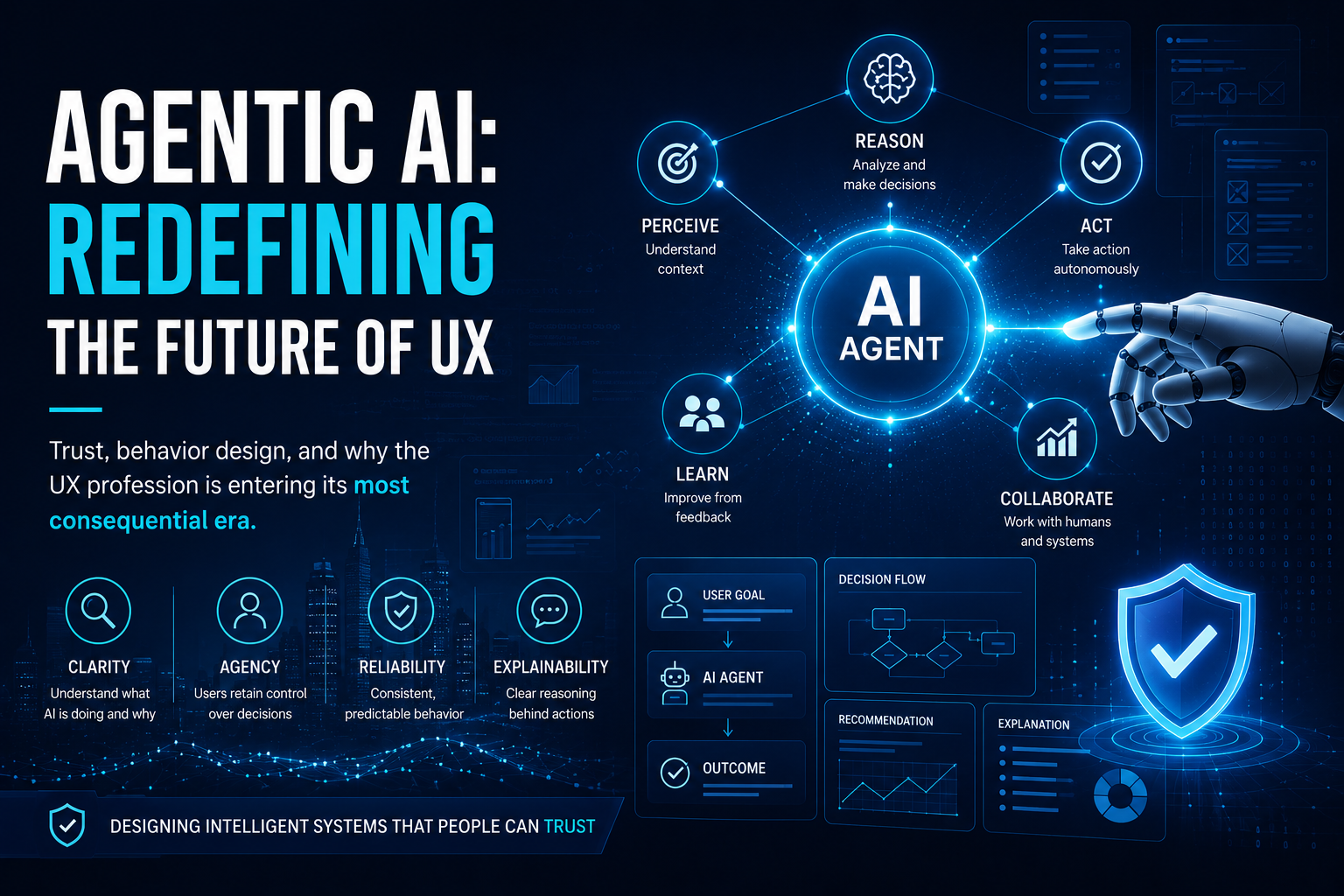
Agentic AI: Redefining the Future of UX
Sneha Mali · UI/UX Designer· 4A Consulting
AI is no longer a future trend; it is already changing how people work, communicate, and make decisions. According to Microsoft, GitHub, and McKinsey research, organizations deploying AI copilots are reporting productivity gains ranging from 20% to more than 50%, particularly across knowledge-intensive functions. Yet productivity may ultimately be the least transformative outcome. The larger shift is that technology is beginning to make decisions, not simply execute instructions. But this shift goes beyond efficiency gains. For the first time, technology is evolving from passive tools into active participants. Instead of waiting for instructions, AI systems can understand context, make decisions, predict needs, and act independently.
For UX professionals, the central question is no longer how to design better screens. It has become: how do we design intelligent systems that people can trust?
Similar to how mobile computing reshaped customer engagement and cloud transformed operating models, agentic AI is redefining the relationship between humans and technology. The organizations that recognize this as a business transformation rather than a technology upgrade will likely establish the next generation of competitive advantage. That framing misses the point entirely. AI agents don’t just perform tasks better; they change who initiates action, who makes decisions, and who bears responsibility for outcomes.
When a system can act on a user’s behalf without explicit instruction, design can no longer stop at the screen. The questions shift: not “is this button clear?” but “should the agent act here at all?” Not “can the user find what they need?” but “does the user still feel in control?” Logic, judgment, and trust become the new design materials and that demands a fundamentally different kind of practitioner.
Gartner predicts that by the end of the decade, a meaningful percentage of routine business decisions will be augmented or executed by AI-enabled systems. The implication is significant: organizations are not simply deploying software. They are introducing digital actors into operational workflows.
Traditional UX | Agentic AI UX |
Static screens & navigation flows | Dynamic behaviors and decision logic |
User → Interface → Action → Outcome | User → Agent → Decision → Outcome |
Designing layouts & visual hierarchy | Defining when AI acts vs. when users lead |
Error prevention through UI constraints | Trust design through transparency & recovery |
Single-channel interaction | Multi-agent, context-aware collaboration |
AI agents are systems designed to perform tasks independently based on goals, context, and user behavior. Unlike traditional software that follows fixed commands, these systems learn patterns, make recommendations, and act proactively.
Consumer Domain | Capability | Enterprise Domain | Capability |
Travel planning | Monitor prices, compare options, and book automatically | Workplace | Summarize meetings, prioritize tasks, and draft communications |
Healthcare | Manage medications, appointments & recommendations | Customer service | Resolve inquiries end-to-end with minimal human handoff |
Personal finance | Track spending, surface anomalies, and suggest adjustments | Operations | Monitor systems, predict issues, trigger responses |
Unlike traditional software, these systems are no longer simply tools. They are becoming digital partners. And that shift fundamentally changes user expectations and designer responsibilities.
The CARE Model: A Framework for Designing AI Experiences
As UX expands beyond screens, designers need a new way of thinking about what quality means. Traditional heuristics, clarity, efficiency, and consistency still apply, but they are insufficient for systems that act autonomously.
C | Clarity | Can users understand what the AI is doing and why? |
A | Agency | Do users retain meaningful control over AI decisions? |
R | Reliability | Does the system behave consistently and predictably? |
E | Explainability | Can users understand the reasoning behind AI actions? |
The challenge shifts from helping users complete tasks to designing systems that users are willing to delegate authority to. In an agentic environment, trust becomes the currency that determines adoption, engagement, and long-term success. There are different problems with different solutions.
Research consistently shows that users are more likely to accept AI recommendations when systems explain both the reasoning and confidence behind decisions. Transparency is no longer a design enhancement. It is rapidly becoming a business requirement. This is not a UX preference; it is a fundamental requirement for adoption.
When AI starts acting independently, users naturally ask: Why did the system do that? What trust design requires in practice:
- Clear explanations of AI decisions not just what happened, but why
- Predictable interaction patterns that users can learn and rely on
- Transparent recommendations that distinguish AI suggestions from user choices
- Approval mechanisms for high-stakes or irreversible actions
- Graceful failure modes that recover without eroding confidence
Usability alone is not enough. In agentic systems, designing trust is one of UX’s most important responsibilities and one of the least understood.
Three Visible Shifts Already Underway
This shift has practical implications for how designers work, what skills they need, and what questions they ask. Three changes are already visible in organizations integrating AI agents into their products.
1. Designers Become Decision Architects and Risk Managers
AI systems increasingly influence choices, priorities, and behaviors. That means UX professionals move beyond interface design into strategic decision-making — defining not just what users see, but what the system does when users are not watching.
Every automated decision introduces potential operational, ethical, and reputational consequences. UX leaders will increasingly partner with business, legal, security, and technology teams to govern how intelligent systems behave under both expected and unexpected conditions.
2. Behavioral design replaces interaction design
The craft shifts from designing how users interact with a screen to defining how a system behaves across contexts. This requires systems thinking, scenario modeling, and understanding of how autonomous systems influence human behavior over time.
3. Ethics Becomes a Competitive Differentiator
- Is this behavior ethical and transparent?
- Does automation increase or reduce user control over time?
- What long-term habits or dependencies does this create?
- Does this design build genuine confidence or create false assurance?
Organizations that establish transparent, responsible AI experiences may gain a measurable advantage in customer trust, employee adoption, and brand credibility. Ethics is increasingly becoming a business outcome, not simply a compliance consideration.
For decades, organizations asked:
“How can technology help employees work faster?”
Agentic AI introduces a different question:
“What decisions should technology make on behalf of employees, customers, and stakeholders?”
The distinction matters. Speed creates efficiency. Decision-making creates accountability.
As organizations deploy AI agents across customer service, healthcare, finance, and operations, governance, transparency, and trust will become as important as technical performance.
Final Thoughts
AI agents are transforming technology from passive tools into active collaborators. For UX professionals, the opportunity is much larger than designing interfaces. The future of UX involves shaping trust, behavior, ethics, and intelligent decision-making.
At 4A, we believe the next generation of digital transformation will not be defined by how much AI organizations deploy, but by how effectively they govern, design, and scale intelligent experiences. Organizations that successfully balance automation with human trust will be positioned to lead in the agentic era.
The future of UX is not simply about designing interfaces.
It is about designing the relationship between humans and intelligent systems.
The organizations that get that relationship right will define the next decade of innovation.