




At 4A Consulting, we’re excited to share an incredible milestone in our journey. Recently, we were featured as one of the top 8(a) small businesses driving transformative change at the Internal Revenue Service (IRS). This recognition by Orange Slices is a significant testament to the hard work and dedication of our talented team, and our ongoing commitment to delivering impactful solutions for federal agencies.
AI Hallucinations: Why They Happen and How to Reduce Them
A few months ago, I saw an AI model generate code that looked completely correct at first glance, but it introduced subtle bugs and referenced methods that didn’t even exist. The code compiled, the logic seemed sound, and nothing flagged it as wrong until I hit testing and started failing in ways that took hours to trace.
That’s the thing about hallucinations. They don’t announce themselves. The output was “polished enough to pass a quick review”, and that’s exactly what made it dangerous.
Hallucinations are probably the most misunderstood failure mode in AI today. People either dismiss them as a minor quirk or treat them as proof that AI is fundamentally untrustworthy. The truth is more nuanced, and more fixable, than either side admits. And this is not a low-quality model problem; it affects the most advanced frontier models available today.
The term gets thrown around loosely. In the context of large language models, a hallucination is when the model produces output that is factually wrong, fabricated, or internally inconsistent, stated with complete confidence and no disclaimer.
It is not a glitch. It is not the model lying. It is closer to the model doing exactly what it was trained to do, which is predict the most plausible next token, and getting the answer wrong because plausibility and truth are not the same thing.
What hallucination really means: “The model isn’t lying. It’s predicting the most plausible next word. The problem is that plausible and true are not the same thing.”
Language models are trained on enormous amounts of text. They learn statistical patterns: which words follow which, how ideas are typically phrased, what a well-formed answer looks like. What they do not learn is a verifiable model of the world.
A few specific triggers make hallucinations more likely:
- Knowledge gaps. When a model is asked about something outside its training data or beyond its cutoff date, it often fills the gap with something that sounds right rather than admitting uncertainty.
- Overconfident prompting. If you ask a question in a way that presupposes an answer exists, the model will usually try to provide one.
- Long context drift. In very long conversations or documents, models can lose track of earlier constraints and start contradicting themselves.
- Rare or niche topics. The less training data exists on a subject, the more the model has to extrapolate, and the more likely it is to get things wrong.
None of this is unique to one model or one company. It is a structural feature of how these systems work, not a bug that the next update will quietly fix.
The confidence problem
What makes hallucinations genuinely dangerous is not the error itself. It is that the model delivers wrong information with the same fluency and authority as correct information: no hesitation, no disclaimer, no change in register. You have to already know the answer to catch the mistake.
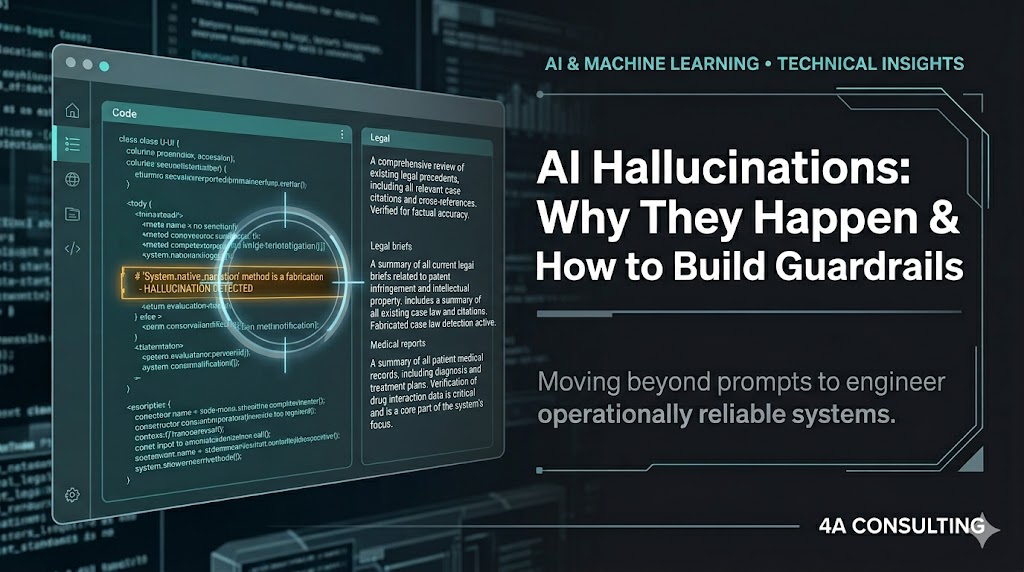
Consider what this looks like outside software engineering. A legal team using AI to summarize case precedents may receive confident citations to cases that do not exist. A healthcare organization automating clinical documentation may see plausible-sounding but inaccurate drug interaction details. A federal agency generating policy summaries may get accurately structured responses built on fabricated regulatory references. In each scenario, the output passes a visual scan. The damage only surfaces after decisions have already been made.
The real risk: “When AI fabricates a legal citation, a drug interaction, or a policy reference, the output still looks authoritative. Organizations that skip verification are not just taking a technical risk; they are taking an operational and reputational one.”
You cannot eliminate hallucinations entirely from today’s models. But you can meaningfully reduce them, and more importantly, reduce the damage they do when they happen.
- Ground the model in sources. Retrieval-augmented generation (RAG) lets the model pull from a verified knowledge base before answering. This dramatically reduces fabricated facts because the model is working from real documents, not reconstructed memory.
- Ask for citations explicitly. Prompting the model to cite its sources doesn’t guarantee accuracy, but it creates a paper trail you can audit. It also tends to make the model more careful.
- Reduce the pressure to answer. Models hallucinate more when they feel forced to respond. Prompts that explicitly give the model permission to say “I don’t know” produce fewer fabrications.
- Use temperature settings deliberately. Higher temperature means more creative and more likely to wander into fiction. For factual tasks, keep it low.
- Build a verification step. For anything that matters, treat the model’s output as a first draft, not a final answer. A second model, a human reviewer, or a structured fact-check catches most of what slips through. More AI programs mature teams layer in evaluation frameworks that score outputs against ground-truth references, set confidence thresholds that trigger mandatory human review, and track hallucination rates by task type over time. This turns a one-time prompt into a measurable, auditable process.
Practical fix: “Giving the model explicit permission to say it doesn’t know reduces fabrications significantly. The model hallucinates more when it feels forced to fill the gap.”
How we approach this at 4A Consulting
At 4A, we treat hallucination risk as a design constraint, not an afterthought. When building AI-assisted workflows for agencies and enterprises, we start by mapping the risk surface: which outputs are high-stakes, which knowledge domains have thinner training coverage, and what the real-world failure modes look like if something slips through. That analysis shapes the architecture, from retrieval layer design to human review thresholds to confidence scoring configurations.
In practice, this means we build guardrails before we build features. We define what verification standards means for a given output type. We create escalation paths for low-confidence responses. And we instrument workflows so teams can monitor and improve hallucination rates over time. The goal is not a perfect model (no such thing exists). The goal is a reliable system around an imperfect one. That distinction matters more than most organizations realize, and it is where strong engineering judgment still makes the difference.
Hallucinations are not going away any time soon. The architecture that makes language models useful, predicting the most plausible continuation of text, is the same architecture that makes them capable of confident errors. This is not a defect waiting to be patched. It is a structural property of the technology that every team deploying AI must plan around.
Responsible AI adoption means building governance, validation, and human oversight into every workflow, not as a compliance checkbox, but as a core engineering discipline. Verify high-stakes outputs. Set confidence thresholds that trigger human review. Use retrieval when accuracy matters. Instrument your systems so you can measure and improve over time.
Organizations succeeding with AI are not the ones chasing the newest model. They are the ones building auditable, scalable systems with the right guardrails from the start. At 4A Consulting, that is exactly what we help agencies and enterprises do: design AI workflows that are operationally reliable, measurable, and built to last. If your organization is ready to move beyond AI experimentation and toward reliable enterprise deployment, 4A Consulting can help.