




At 4A Consulting, we’re excited to share an incredible milestone in our journey. Recently, we were featured as one of the top 8(a) small businesses driving transformative change at the Internal Revenue Service (IRS). This recognition by Orange Slices is a significant testament to the hard work and dedication of our talented team, and our ongoing commitment to delivering impactful solutions for federal agencies.
OPTIMIZING POWER APPS AT SCALE
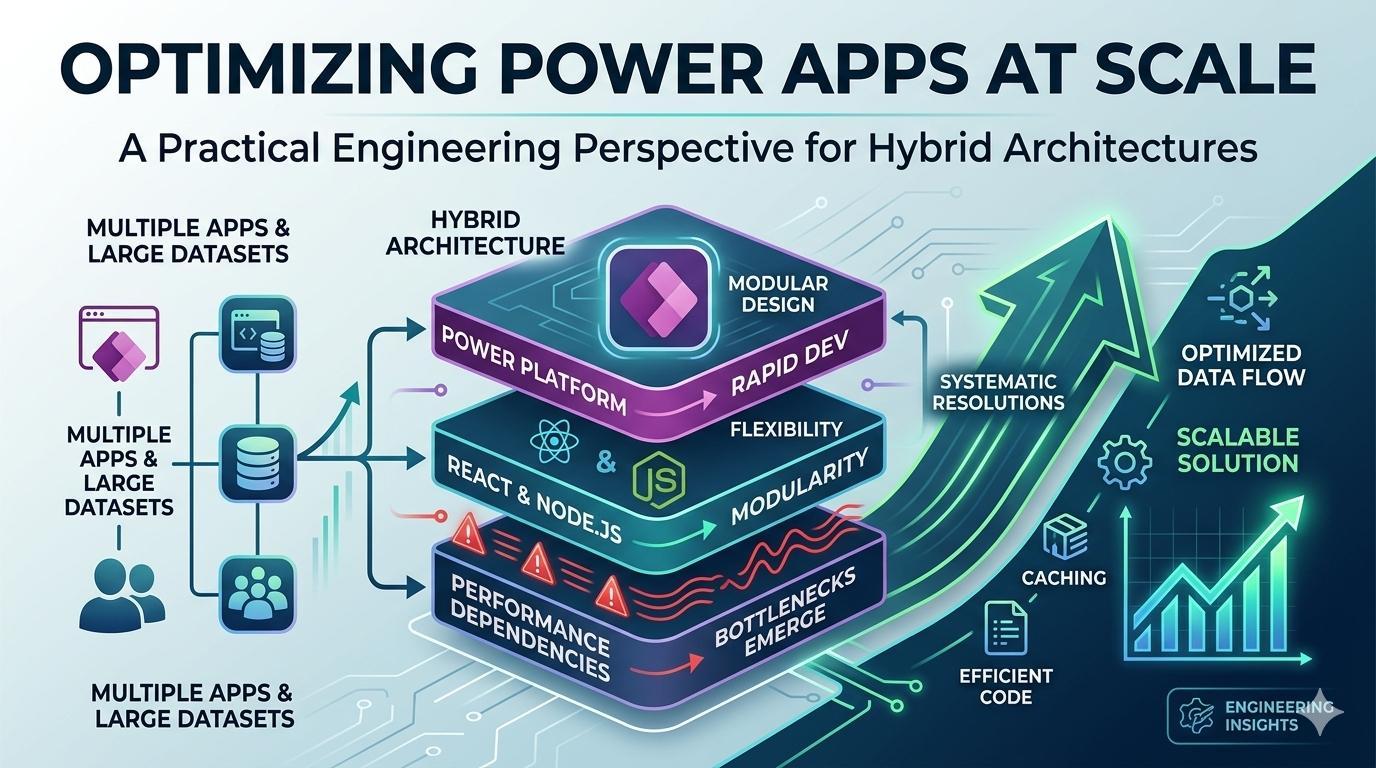
Power Apps enable rapid application development, but performance becomes a critical concern as solutions scale across multiple apps, large datasets, and real users.
This blog presents a practical engineering perspective on optimizing Power Apps within a hybrid architecture combining React, Node.js, and the Power Platform. This structure enabled flexibility and modularity but also introduced performance dependencies across layers. It focuses on how performance bottlenecks emerge and how they can be systematically resolved.
This reflects the type of real-world performance and scalability challenges 4A Consulting addresses when supporting enterprise Power Platform and low-code implementations.
The solution used a hybrid architecture combining React, Node.js, and Microsoft Dynamics tools. A React-based wrapper application embedded the Power App solutions using iframes. Data was sourced from SharePoint lists, with automation handled through Power Automate flows.
Designing and supporting hybrid architectures like this is a common pattern in 4A Consulting’s approach to integrating low-code platforms with full-stack systems.
Problem: Performance Degradation at Scale
Initially, the application performed as expected, delivering a smooth and responsive user experience. However, as usage increased and data volumes grew, the system began to show measurable performance issues:
- Increased initial load time (up to ~175% slower)
- Delayed UI rendering across screens
- Complex and deeply nested UI structures
While the application remained functionally correct, overall user experience degraded significantly.
“In user-facing systems, performance is not optional, it defines usability.”
The issue was not platform limitation, but rather architectural decisions within Power Apps. Through structured performance analysis aligned with 4A Consulting’s optimization approach, the following inefficiencies were identified:
- Heavy operations triggered before user interaction
- Overuse of nested containers, increasing render cost
- Redundant UI components performing similar tasks
- Inefficient use of global variables
“Power Apps performance is heavily dependent on when and where logic runs and not just what it does.”
Rather than rewriting the application, the focus was on targeted structural optimizations.
The Optimization Strategy
Applying a targeted optimization approach commonly used by 4A Consulting, the focus was on structural improvements rather than full re-engineering.
- UI Simplification
Changes:
- Replaced deeply nested containers with simplified layouts
- Consolidated repeated components into single Gallery controls
- Used HTML Text controls for flexible, dynamic rendering where appropriate
Outcome:
- Reduced rendering overhead
- Improved screen load responsiveness
- Simplified UI maintenance
- Execution Optimization & State Management
The OnStart was overloaded with data loading, variable initialization, and business logic.
Changes:
- Moved heavy operations to OnSelect (event-driven execution)
- Deferred non-critical logic until after user interaction
- Shifted global variables to the Formulas section
- Centralized reusable variables
Outcome:
- Faster initial load time (~73% improvement observed)
- More predictable execution behavior
- Improved maintainability and scalability
“Performance improved not by reducing logic, but by executing it at the right time.”
The Role of AI: Enabling Faster, Better Decisions
Refactoring a working application carries inherent risk, especially in production systems. AI tools played a critical role in reducing that risk by supporting informed decision-making. This reflects how 4A Consulting leverages AI-assisted engineering to accelerate analysis, reduce risk, and improve decision quality in complex system optimizations.
Practical contributions:
- Identified Power Apps performance best practices
- Highlighted platform-specific limitations (e.g., control rendering costs)
- Suggested alternative UI patterns (Gallery vs Containers)
- Helped validate architectural changes before implementation
Impact:
- Reduced trial-and-error cycles
- Increased confidence in structural changes
- Accelerated optimization without compromising stability
Business Impact
These outcomes align with 4A Consulting’s focus on delivering scalable, high-performance solutions that balance speed, usability, and long-term maintainability.
- Improved user experience through faster load times and smoother navigation (~25% improvement from baseline)
- Enhanced scalability, supporting larger datasets and concurrent users
- Reduced maintenance overhead with cleaner, modular structure
- Faster iteration cycles for future enhancements
These improvements directly contribute to higher user adoption, improved operational efficiency, and reduced long-term technical debt.
Why This Matters for Enterprises
As organizations scale Power Platform solutions across departments, performance becomes a business-critical factor , not just a technical concern. Poorly optimized applications can slow decision-making, reduce user adoption, and increase long-term maintenance costs.
This approach demonstrates that with the right architectural discipline, Power Apps can scale effectively while maintaining performance, usability, and extensibility across enterprise environments.
The Developer Perspective: Low-Code Still Needs Engineering Discipline
Power Apps simplifies development, but at scale, it requires the same engineering principles as traditional systems:
- Performance optimization
- Efficient state management
- Thoughtful UI design
- Clear separation of concerns
Scaling Power Apps requires more than low-code convenience as it requires intentional architecture. By optimizing when logic executes, how UI is structured, and how state is managed, organizations can significantly improve performance without rebuilding from scratch.
Conclusion: Engineering Discipline Defines Scale
Power Apps accelerates development, but at scale, performance is determined by architectural decisions not platform capability.
This case highlights that meaningful performance gains do not require rebuilding applications, but rather rethinking execution timing, UI structure, and state management.
Organizations that treat low-code platforms with the same engineering rigor as traditional systems are better positioned to scale efficiently, adapt quickly, and deliver consistent user experiences.
This is the foundation of how 4A Consulting approaches scaling low-code platforms in enterprise environments.
Scaling Power Platform solutions requires more than rapid development as it requires the right architecture and performance strategy. 4A Consulting partners with organizations to design, optimize, and scale low-code platforms for enterprise environments.
Learn how we can help you improve performance, reduce complexity, and maximize the value of your Power Platform investments.

Lorem ipsum dolor sit amet, consectetur adipiscing elit. Ut elit tellus, luctus nec ullamcorper mattis, pulvinar dapibus leo.