



At 4A Consulting, we’re excited to share an incredible milestone in our journey. Recently, we were featured as one of the top 8(a) small businesses driving transformative change at the Internal Revenue Service (IRS). This recognition by Orange Slices is a significant testament to the hard work and dedication of our talented team, and our ongoing commitment to delivering impactful solutions for federal agencies.
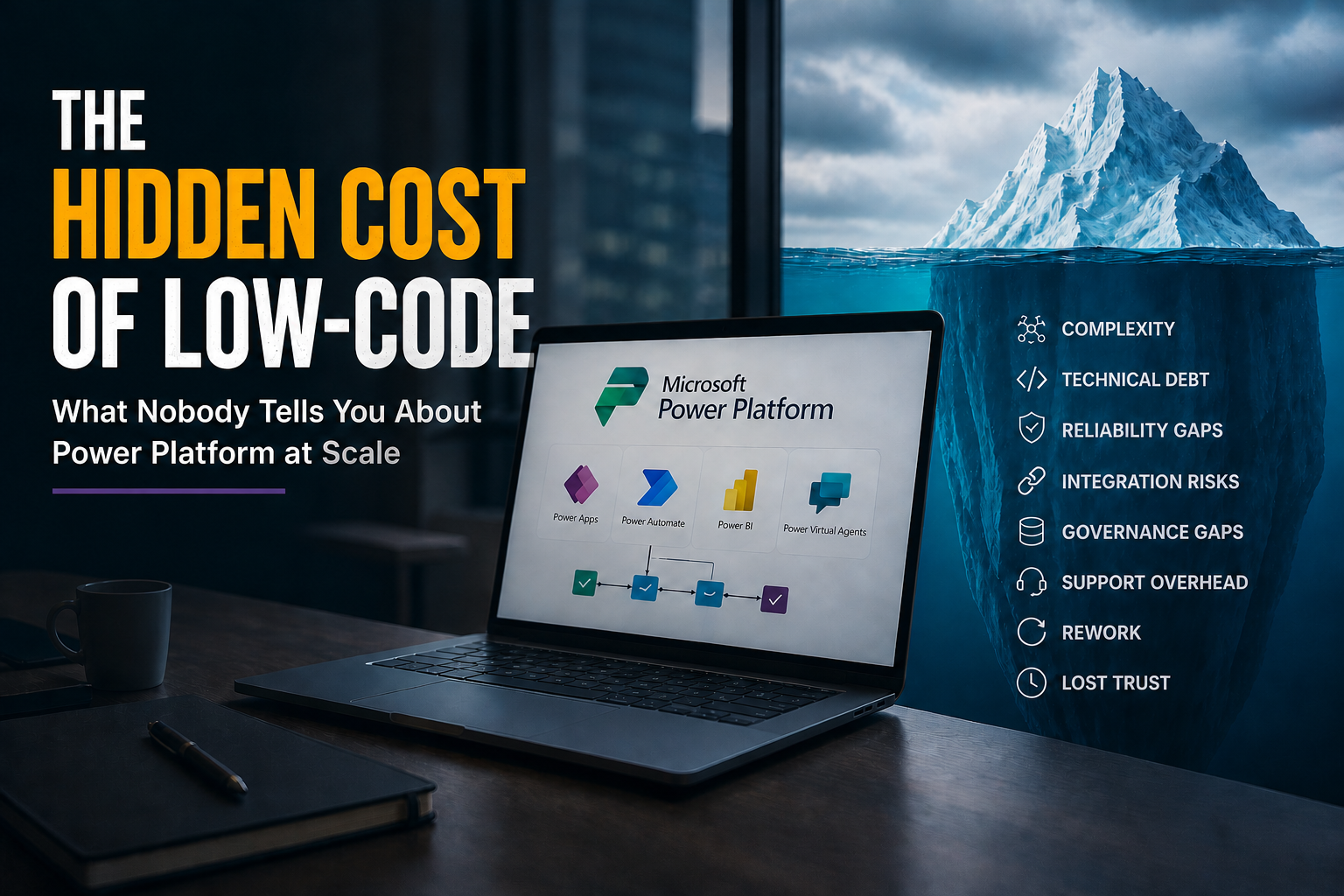
The Hidden Cost of Low-Code: What Power Platform Really Costs at Scale
Low code has become one of the biggest success stories in enterprise technology.
It is fast. It is accessible. It delivers results.
That is exactly why Microsoft Power Platform has become a go-to solution for workflow automation, approvals, HR operations, reporting, and process modernization. Teams can move from business problem to working solution in weeks rather than months. Manual work gets replaced. Visibility improves. Bottlenecks shrink.
All of that is true.
What gets overlooked is what happens next.
The initial app is typically the less expensive part of the lifecycle. The true cost appears when five teams rely on it, business rules multiply, integrations begin failing at the edges, and a “simple workflow” turns into a system no one intended to scale. That is where the hidden cost of low code begins.
“Power Platform does not fail at scale because it is low code. It fails when organizations mistake speed for simplicity.”
This is not a criticism of Power Platform. It is the opposite Power Platform is one of the strongest enterprise platforms for rapid solution delivery. But speed by itself is not a strategy. Without architecture, governance, and delivery discipline, quick fixes become costly systems.
Power Platform succeeds because it closes one of the biggest gaps in enterprise delivery: the gap between business demand and implementation.
A team spots a bottleneck. A form gets built. A flow automates approvals. A dashboard creates visibility. A manual process disappears. What once lived in spreadsheets, inboxes, and follow-up calls becomes structured and trackable.
That is why low code continues to win.
It delivers value quickly in areas such as:
- Employee operations
- Document workflows
- Case management
- Approvals
- Reporting
- Cross-functional process automation
And for many organizations, that speed is not just useful. It is essential.
But early success creates a dangerous assumption if it was easy to launch, it must be easy to scale.
That assumption is where the real cost starts building.
Most Power Platform solutions start small.
One app. One flow. One team. A handful of fields.
Then reality sets in.
Now the process depends on role-based access, conditional approvals, status-driven actions, attachments, date rules, escalations, related records, exception handling, audit requirements, and integrations with other systems. The app is no longer supporting work. It is running work.
And that changes the cost profile immediately.
This is what many teams overlook: low-code complexity does not increase gradually. It compounds.
A basic intake form becomes an onboarding workflow. A status tracker becomes an operational system. A document step becomes a departmental dependency. What started as a quick fix becomes company infrastructure.
The Debt Nobody Notices Until It Slows Everything Down
One of the biggest myths in low-code is that it reduces the need for engineering discipline.
It does not.
Low-code reduces how much code you write by hand. It does not remove architecture, validation, data modeling, integration design, lifecycle management, testing, or support readiness. Those demands still exist. They just show up differently.
In Power Platform, that debt usually shows up as:
- Duplicated business logic across apps and flows
- Fragile expressions with hidden dependencies
- Inconsistent data relationships
- Workflows that only succeed under ideal inputs
- Environment drift between dev, test, and production
- Changes that are hard to test safely
That is still technical debt. It just arrives in a faster delivery model.
Most organizations do not recognize that debt until later, when releases slow down, support requests increase, and trust in the solution starts to decline. Low-code creates early wins, which makes the underlying issues easier to miss.
“Low code reduces how much code you write. It does not remove the need for architecture, validation, or governance.”
When ‘Working’ Stops Being Good Enough
This is where many Power Platform initiatives hit the wall.
A solution can work perfectly in a demo and still fail in production.
Not because the platform is weak. Because production is messy.
Users skip steps. Records are incomplete. Lookup values are blank. Attachments arrive inconsistently. Integrations return partial data. Business logic changes faster than the app design. A workflow that looked clean in development starts to break under real operating conditions.
That is the gap between working and being reliable.
In enterprise delivery, reliability is what matters.
Example 1: One Missing Value, One Broken Workflow
One blank lookup can seem insignificant. In practice, it can disrupt an entire automated path, prevent downstream updates, and halt record generation. In one common enterprise pattern, one missing related-record reference can interrupt a workflow involving 6+ status conditions, multiple document checkpoints, and several dependent actions. What looks like a one-field problem quickly becomes a cross-process failure.
Example 2: The “Small Change” That Touches Everything
A process that starts with one status update often grows into a rule’s engine. One workflow can easily expand to 8–10 branching conditions, document validation rules, exception paths, holiday and weekend handling, and separate actions for different operational teams. At that point, changing one rule is no longer a small update. It becomes a production change with downstream impact across the solution.
Example 3: Integrations Fail at the Edges, Not the Demo
A document flow, API call, or SharePoint handoff may work perfectly in isolation and still fail under real-world timing conditions. The file exists, but not yet where the next process expects it to be. The response returns data, but not in the exact structure the automation expects. In integration-heavy solutions, one timing or reference mismatch can disrupt a process touches multiple systems, several record relationships, and dozens of user actions per cycle.
At scale, these are not rare edge cases. They are normal operating conditions.
“A solution can work beautifully in a demo and still fail in production. That is the gap between working and being reliable.”
Reliable systems require:
- Strong validation
- Predictable data structures
- Clear exception handling
- Resilience across flows
- Alignment between UI behavior and backend logic
- Visibility into failures before users discover them
Without that, useful solutions become hard to trust.
Power Platform becomes even more valuable when it connects to the broader enterprise stack.
Dataverse, SharePoint, SQL, APIs, identity platforms, reporting tools, and document services can turn a simple app into a powerful connected system.
They also expose every weak assumption in the design.
Every integration adds a dependency:
- The data must exist
- Identifiers must be valid
- Payloads must align
- Timing must hold
- Downstream processes must be able to handle exceptions
For that reason, integration-heavy low-code solutions require real technical rigor.
“Connectors stop being conveniences at scale. They become architecture.”
The Governance Bill Always Shows Up
Governance is often treated like something to add later.
That is one of the most expensive mistakes teams make in Power Platform delivery.
By the time governance enters the conversation, the symptoms are already visible:
- Apps built differently across teams
- Business logic spread across too many places
- Inconsistent deployment practices
- Unclear ownership
- Security that is harder to reason about
- Small changes carrying outsized risk
Strong Power Platform programs establish:
- Environment strategy
- ALM and deployment standards
- Role-based security design
- Connector controls
- Naming conventions
- Monitoring and support practices
- Ownership and change control
Without those guardrails, speed turns into sprawl.
“Governance is not what slows innovation. The absence of governance is what slows it later.”
What Mature Power Platform Delivery Actually Looks Like
The answer is not to slow down low-code adoption.
The answer is to mature it.
The best Power Platform programs do not treat apps and automations like isolated wins. They treat them as enterprise products.
That means:
- Defining process rules before automating them
- Designing Dataverse relationships with intention
- Validating critical data before it enters workflows
- Reusing patterns instead of rebuilding logic repeatedly
- Testing against real-world conditions, not just happy paths
- Designing flows for resilience, not just completion
- Embedding governance into delivery from the start
- Planning for support, scale, and change
Organizations that do this well are not resisting low code.
They are proving what low-code can become when it is backed by enterprise discipline.
The Real Cost Is Not Licensing. It Is Rework.
That is the part not enough teams say out loud.
The hidden cost of low code is rarely the platform itself. It is the accumulated cost of brittle workflows, duplicated logic, support overhead, production instability, and lost trust when business-critical processes stop behaving predictably.
Power Platform remains one of the strongest platforms for rapid enterprise transformation. But speed is not the finish line.
A solution is never truly complete if it cannot withstand growth, integrations, exceptions, and change. It was only launched.
“The hidden cost of low code is rarely licensing. It is rework, fragility, support overhead, and lost trust.”
Organizations can modernize operations faster with Power Platform than with nearly any other business platform on the market today. Ensuring those solutions continue to function when complexity arises is the hard part.
That is where 4A Consulting adds value.
We help clients move beyond fast wins to build Power Platform solutions that are scalable, governed, integration-ready, and durable under real business demand. Our goal is not just to get solutions live. It is to ensure they endure as adoption increases, workflows grow, and enterprise expectations rise. If your organization is quickly with low code but starting to feel the strain of rework, support burden, or process instability, the platform is not the problem. The delivery model may be.
4A Consulting helps close that gap turning Power Platform speed into enterprise-grade execution.
Lorem ipsum dolor sit amet, consectetur adipiscing elit. Ut elit tellus, luctus nec ullamcorper mattis, pulvinar dapibus leo.