




At 4A Consulting, we’re excited to share an incredible milestone in our journey. Recently, we were featured as one of the top 8(a) small businesses driving transformative change at the Internal Revenue Service (IRS). This recognition by Orange Slices is a significant testament to the hard work and dedication of our talented team, and our ongoing commitment to delivering impactful solutions for federal agencies.
Are LeetCode Interviews Still Relevant in 2026?
Software engineering interviews have evolved significantly over the past decade. Platforms like LeetCode became the dominant way companies evaluate candidates, shaping how engineers approach technical interview preparation.
But in 2026, the conversation is shifting. Many engineers and hiring managers are questioning whether solving algorithm puzzles truly reflects the skills required to succeed in real engineering roles.
While the industry is evolving, the reality is more nuanced: LeetCode-style interviews still play an important role, but they are no longer the whole picture.
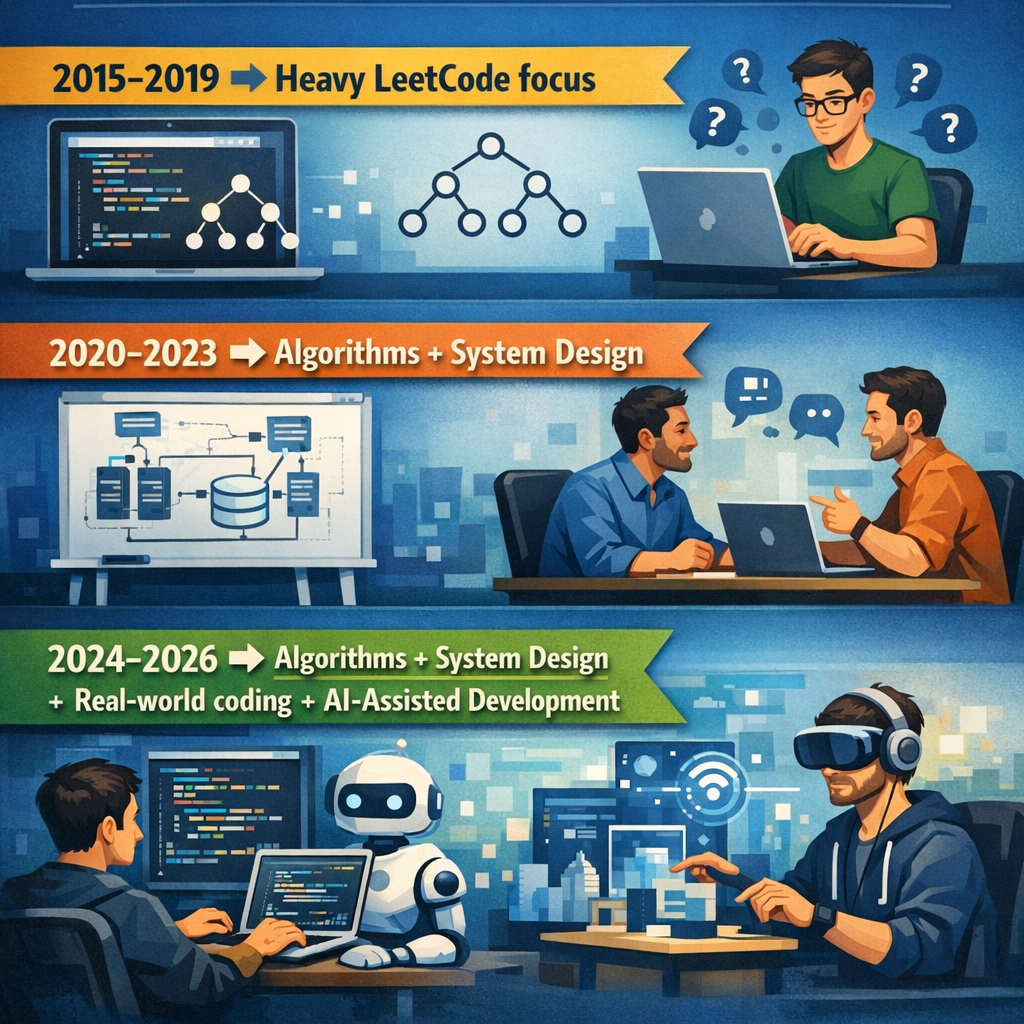
Technical interviews did not evolve randomly. Each phase reflects how the software industry itself changed.
| Era | Primary Focus | The “Why” Behind the Shift |
|---|---|---|
2015-2019 | Data Structures & Algorithms (The “LeetCode Era”) | Standardized Filtering: Companies, especially large tech firms, needed a scalable and objective way to evaluate massive applicant pools. The assumption was simple: if someone could master complex CS fundamentals, they were smart enough to learn the rest of the tech stack on the job. |
| 2020–2023 | System Design (The “Scale Era”) | Cloud-Native Complexity: As microservices, distributed systems, and large-scale cloud infrastructure became the norm, algorithm puzzles alone were insufficient. Engineers needed to understand databases, caching, architecture trade-offs, and how to design systems that scale without breaking. |
| 2024–2026 + | Real-World & AI-Assisted (The “Pragmatic Era”) | Immediate ROI & Tooling: The post-2023 tech market forced companies to prioritize engineers who can deliver business value quickly. At the same time, AI tools like GitHub Copilot and Cursor changed how developers write code. Memorizing syntax matters far less than understanding systems, debugging codebases, and using AI effectively to accelerate development. |
This shift explains why modern interviews increasingly combine algorithm questions with system design discussions, debugging exercises, and practical coding tasks.
LeetCode-style interviews gained popularity because they provided a scalable and relatively objective way to evaluate candidates. Large technology companies often receive thousands of applications for engineering roles, and standardized algorithmic questions helped create a consistent evaluation process.
These problems allow interviewers to assess:
- Problem-solving ability
- Logical reasoning
- Understanding of core computer science concepts
- Coding proficiency under constraints
Standardized algorithmic challenges also help level the playing field across candidates from different universities, backgrounds, and levels of experience.
Preparation tip: Focus on mastering foundational data structures such as arrays, trees, graphs, and hash tables. These concepts form the backbone of many interview questions.
At their core, LeetCode-style interviews measure structured problem-solving ability.
Candidates must:
- Understand the problem and constraints
- Design an efficient solution
- Analyze time and space complexity
- Implement the solution clearly
These skills are valuable because software engineering often involves breaking complex problems into smaller, manageable parts.
For example, understanding algorithms like shortest-path searches or efficient sorting can translate to real-world tasks such as building recommendation systems, optimizing search functionality, or improving application performance.
Key mindset: Treat algorithm practice as training for analytical thinking—not just memorizing patterns.
Despite their strengths, algorithm-focused interviews only capture part of what engineers do on the job.
Real-world software engineering involves:
- Designing scalable systems
- Working with large codebases
- Debugging complex issues
- Collaborating across teams
- Writing maintainable and readable code
An engineer who performs well on algorithm puzzles might still struggle with practical challenges such as designing APIs, optimizing database queries, or troubleshooting distributed systems. Because of this gap, many companies have started expanding their interview processes beyond algorithm questions.
Modern interview processes increasingly include additional evaluation methods such as:
- System design interviews
- Take-home coding projects
- Collaborative pair-programming exercises
- Discussions about real engineering trade-offs
These formats help companies evaluate how candidates approach real-world problems, communicate technical ideas, and design scalable solutions.
As a result, interviews are gradually becoming more balanced between theoretical knowledge and practical engineering ability.
AI tools are also changing how engineers learn and prepare for interviews.
Developers now use AI assistants to:
- Understand algorithm concepts
- Debug code faster
- Explore multiple solution strategies
- Review system design approaches
While this accelerates learning, it also raises new questions about how companies evaluate independent problem-solving ability.
Some organizations are responding by placing greater emphasis on reasoning, communication, and design discussions, rather than focusing solely on coding tasks.
Recommendation: Use AI as a learning tool but make sure you understand the underlying concepts rather than relying on generated solutions.
Success in modern technical interviews requires a balanced preparation strategy.
Practical preparation approach
- Practice core data structures and algorithms regularly
- Build real projects that demonstrate system design skills
- Learn how databases, APIs, and distributed systems work
- Improve your ability to explain your thinking during interviews
Engineers who develop both theoretical understanding and practical experience will stand out in modern hiring processes.
Several trends are shaping how companies evaluate engineers:
- Real-world coding exercises based on production scenarios
- Collaborative problem-solving interviews
- Greater emphasis on system design and architecture
- Evaluation of debugging and code-reading skills
- Assessment of AI-assisted development workflows
These changes reflect the industry’s growing focus on real engineering capabilities rather than puzzle-solving alone.
Despite ongoing criticism, LeetCode-style interviews are unlikely to disappear anytime soon. Large technology companies still rely on them because they are predictable, scalable, and relatively efficient.
However, the interview process is clearly evolving.
Candidates who focus exclusively on algorithm puzzles may find themselves underprepared for other parts of the interview process.
- LeetCode-style interviews remain relevant but are only one part of evaluation
- Algorithmic thinking is valuable, but not sufficient on its own
- Modern interviews increasingly emphasize system design and real-world engineering
- AI is changing how engineers learn and prepare
- Balanced preparation leads to stronger interview performance
LeetCode still matters in 2026, but it is no longer the entire story.
The engineers who succeed in today’s hiring market combine strong problem-solving ability with practical engineering experience, system design thinking, and clear communication.
If you’re preparing for technical interviews today, the best strategy isn’t just solving more puzzles but it’s building the skills required to design and deliver real systems.
At 4A Consulting, we see the strongest engineers combining deep technical fundamentals with practical system-building experience. Companies increasingly value engineers who can not only solve problems but design scalable, real-world systems.
We help organizations move from AI experimentation to measurable impact. Connect with us to build a strategic AI roadmap, align data and teams, and develop the capabilities needed to lead in 2026 and beyond.
Written By Deepanshu Sharma – Associate AI Engineer